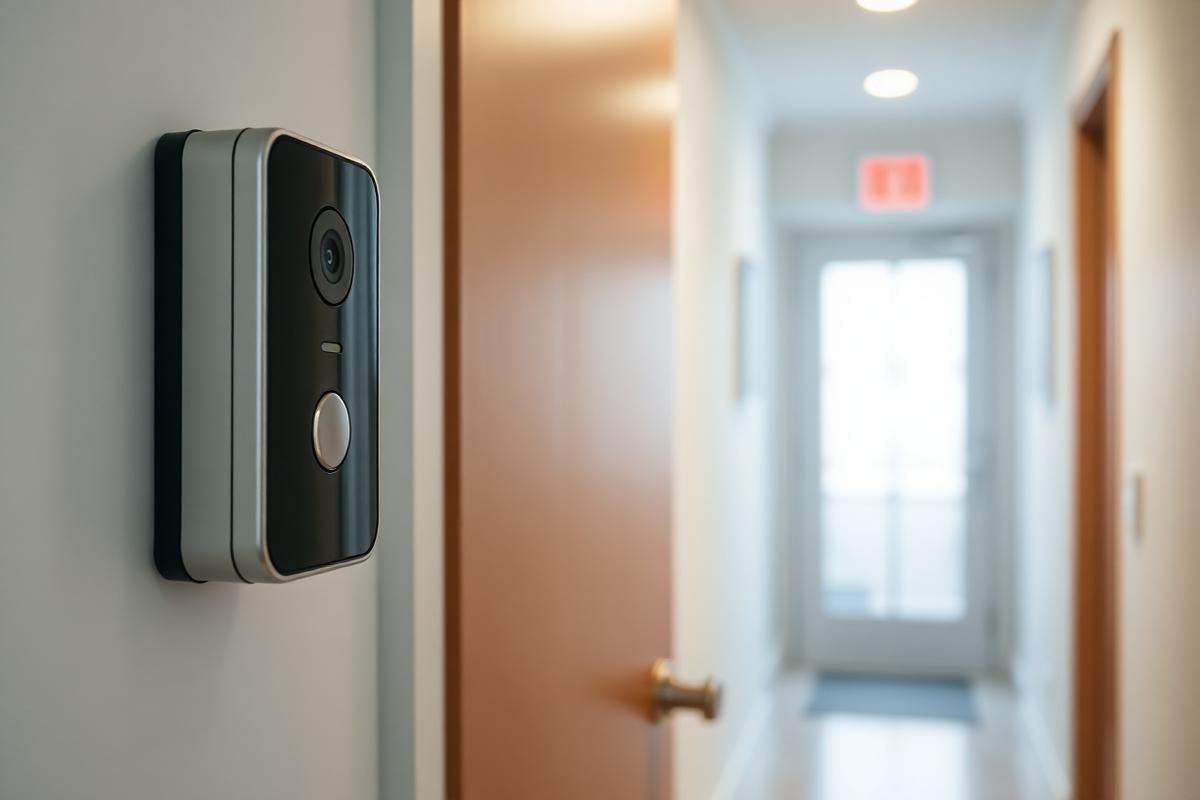
First check: where will the doorbell be fixed?
A leasehold flat is defined by its lease. The parts a leaseholder owns for the term of the lease are the demised premises, and everything else - the structure, the external walls, the common parts - is normally retained by the freeholder or managed on behalf of all residents.
The entrance door, the door frame, the wall beside it and the external or common-side surface may or may not form part of the demise. It depends entirely on the wording of the lease and the plans attached to it. Some leases demise the whole entrance door; some demise only the internal finishes; some are silent or ambiguous.
That matters because if the proposed fixing point forms part of the retained structure or the common parts, the leaseholder should not assume they have the right to drill into it or attach equipment to it. Consent may be required, and fitting something without it can create an avoidable dispute.
The first step is therefore not to buy the device. It is to read the lease, or ask the managing agent, RTM company or RMC what the lease says about the entrance door and the surrounding walls.
Does installing it count as an alteration?
Even where the fixing point does form part of the demised premises, the lease may still restrict what can be done to it.
Leases commonly contain covenants dealing with:
- alterations to the demised premises;
- additions to the building;
- the external appearance or uniformity of the block;
- drilling, fixings and penetrations;
- the installation of fixtures; and
- changes to the flat entrance door.
Whether a video doorbell falls within any of those covenants, and whether formal consent (sometimes a licence to alter) is needed, depends on the wording of the particular lease and on how the device is actually installed.
There is a real practical difference here. A battery-powered unit fixed with adhesive or an existing bracket, causing no penetration and easily removed, may raise different lease issues from a hard-wired device that requires holes, cabling, a transformer or modification of the door. The same lease can produce different answers for the two installations.
What if it records the communal hallway?
This is where flats differ most from houses.
A camera at a flat entrance door within an internal corridor may capture a shared corridor, the communal entrance, a stairwell, a lift lobby, neighbours coming and going from their own flats, their visitors, contractors and delivery drivers.
None of those people are inside the leaseholder's private space. Recording them raises privacy considerations and can bring data-protection obligations into play.
A useful way to think about it: the wider the camera's field of view extends beyond the leaseholder's own private space, the more carefully both the installation and the day-to-day operation of the device need to be considered. A camera looking at a doormat is not the same as a camera surveying an entire corridor.
What about neighbours' front doors?
Where a camera points directly at another flat, it may repeatedly or continuously record when that neighbour leaves, when they return, who visits them, conversations held outside their door and - when the door opens - potentially part of the inside of their home.
Most people would find that uncomfortable, and it is one of the most common triggers for complaints to managing agents about doorbell cameras.
That does not automatically make the system unlawful. But where the device permits it, privacy zones, restricted fields of view, narrowed motion zones and sensible activation settings should be used to reduce recording that serves no real security purpose. Adjusting the angle at installation is usually easier than resolving a neighbour dispute later.
Audio recording can be more intrusive
Audio deserves separate thought.
Many modern video doorbells record sound as well as images, and sound travels further than a camera's useful field of view. A microphone at a flat door can pick up conversations several metres away in a corridor, including conversations that have nothing to do with the person recording.
Audio can therefore be considerably more intrusive than video alone. Before enabling it, it is worth asking whether continuous or wide-ranging audio recording is genuinely necessary for the security purpose being pursued. Where the device allows audio to be limited or switched off, configuring it to collect only what is needed is usually the better starting point.
Does UK data protection law apply?
Where domestic video surveillance captures only activity within the user's own private domestic boundary, the position may fall within the domestic-purpose exemption and data-protection obligations may not bite in the same way.
Where the equipment captures people beyond that private sphere, the picture changes. Current ICO guidance on home CCTV systems - which expressly covers smart doorbells - states that if a camera captures someone else's property, a public area or a communal space, data protection law applies, because images and voices of other people are their personal information.
The ICO guidance sets out what a camera owner should then do. In summary, it says owners should consider what area needs to be covered and what images or audio will be captured, and should not capture more than is needed; should use signage indicating that recording is in operation; should store footage securely and limit access to it; should delete footage regularly or automatically; and should be able to respond appropriately to a request for footage from someone who appears in it. It also says cameras should be pointed away from other people's property, public areas and communal spaces where possible, and that filters or privacy blockers should be applied where they are not.
The ICO guidance also notes that consent from those recorded will rarely be required, because the owner will often have a legitimate reason - protecting themselves, their family and their property - but that the owner must be able to show their interests outweigh the intrusion into others' privacy.
We deliberately do not say that every leaseholder whose doorbell sees a communal corridor must register with the ICO or pay a particular annual fee. The ICO's home CCTV guidance does not say that, and any registration or fee question depends on the individual circumstances. The ICO has also flagged that this guidance is under review following the Data (Use and Access) Act, so the current published version should always be checked.
What does Fairhurst v Woodard tell us?
Fairhurst v Woodard (County Court at Oxford, Case No G00MK161, 2021) is frequently cited in discussions about doorbell cameras, and frequently misdescribed.
The case was a dispute between neighbours concerning several surveillance devices, including a Ring video doorbell and other cameras positioned around a property. The court considered a range of matters: the fields of view of the different devices, audio recording and how far it reached, automatic activation, what the neighbour had been told about the installation, how footage was stored and processed, data protection, and harassment.
What the case does not decide is that video doorbells are illegal, or that all domestic video doorbell use is unlawful. It is a first-instance county court decision on its own facts.
What it does illustrate is more useful and more nuanced: the way surveillance equipment is positioned and operated can create legal problems where it intrudes unnecessarily into a neighbour's property and privacy - particularly where audio capture extends well beyond the user's own boundary. The lesson is about proportionality and configuration, not prohibition.
Can the freeholder, RMC or RTM company refuse permission?
Where consent is required under the lease, the landlord, RMC or RTM company should consider the particular lease provisions and the particular circumstances of the request.
It is wrong to say that consent must always be granted. It is equally wrong to say it can always be refused. Some leases contain qualified covenants where consent is not to be unreasonably withheld; others are worded differently; and some proposed installations raise genuine issues that others do not.
Relevant considerations may include:
- the physical alterations proposed;
- possible damage to common parts;
- fire-door implications;
- the appearance of the block;
- the privacy of other residents;
- the camera's field of view;
- whether audio will be recorded;
- data-protection considerations;
- any history of complaints or nuisance; and
- the proposed method of installation.
Where the lease wording is unclear, or where there is doubt about the ability to withhold consent, legal advice may be appropriate before a decision is communicated.
Fire doors - an important additional issue
Many flat entrance doors are fire-resisting doorsets, certificated as a complete assembly including the leaf, frame, seals and ironmongery.
Drilling into, modifying or running cables through a flat entrance fire door may affect the integrity or the certification of that doorset. That is not a reason to say every video doorbell invalidates a fire-door certificate - it plainly does not, and many installations involve no work to the door at all. The point is that alterations to a fire door require care.
A leaseholder should not drill into or modify a flat entrance fire door without first establishing whether the proposed installation is appropriate and obtaining any consent required. Where work to or near the doorset is proposed, the door manufacturer's instructions or the advice of a fire-door specialist should be followed. Fitting the device to an adjacent wall surface, where the lease permits, often avoids the issue entirely.
For directors, this sits alongside the wider question of who is responsible for fire safety in an RTM block.
What should an RTM or RMC do when a leaseholder asks for permission?
A consistent, documented process is far easier to defend than ad hoc decisions, and it treats residents fairly. A workable sequence is:
- Check the lease and establish the extent of the demise.
- Establish exactly where and how the device will be fixed.
- Confirm whether the flat entrance door is a fire door.
- Ask for the device specification.
- Establish the proposed field of view.
- Ask whether audio will be recorded.
- Consider available privacy zones and motion settings.
- Consider the impact on neighbouring flats.
- Consider the applicable data-protection position.
- Document any consent, and any conditions, clearly and in writing.
Where consent is given and the lease and legal position allow, conditions a company might consider include installation without damage to common parts; no drilling into a fire door without prior approval; a restricted field of view; privacy masking of neighbouring doors; appropriate audio settings; compliance with applicable data-protection law; and removal and reinstatement if the lease requires it on assignment or at the end of the term.
These are matters a landlord, RTM or RMC may wish to consider - not conditions that are automatically enforceable in every case. Whether a particular condition can be imposed depends on the lease and the legal position.
Can an RTM or RMC simply ban all video doorbells?
Blanket policies should be approached carefully.
Whether a general prohibition is workable may depend on the lease wording, the ownership of the doors and common parts, the legitimate security concerns of residents, fire safety, the privacy of other occupiers, the physical installation proposed, and whether reasonable conditions could address the concern without an outright refusal.
A case-by-case approach is often more appropriate than assuming every installation is identical, because they are not: an adhesive-mounted battery unit pointing at a doormat and a hard-wired camera with wide-angle audio pointing down a corridor raise very different questions. We would not express a view on whether any particular blanket prohibition is enforceable - that is a legal question turning on the specific leases in the building.
Practical checklist for leaseholders
Before installing a video doorbell at a flat:
- Check your lease.
- Check whether the intended fixing point is within your demise.
- Ask whether landlord, RTM or RMC consent is required.
- Check whether your entrance door is a fire door.
- Avoid drilling or modifying the door until that is confirmed.
- Check what the camera will actually capture.
- Minimise recording of neighbours and communal areas.
- Review the audio-recording settings.
- Use privacy zones and motion zones where available.
- Consider any applicable data-protection obligations.
- Keep a copy of any written consent.
Where we can help
We manage blocks for RTM companies, RMCs and resident-led boards, and alteration requests of this kind come up regularly. If your board wants a clear, consistent way of handling consent requests - or you are a leaseholder trying to establish what your lease actually permits - our block management and RTM company management services cover exactly this kind of day-to-day decision-making.