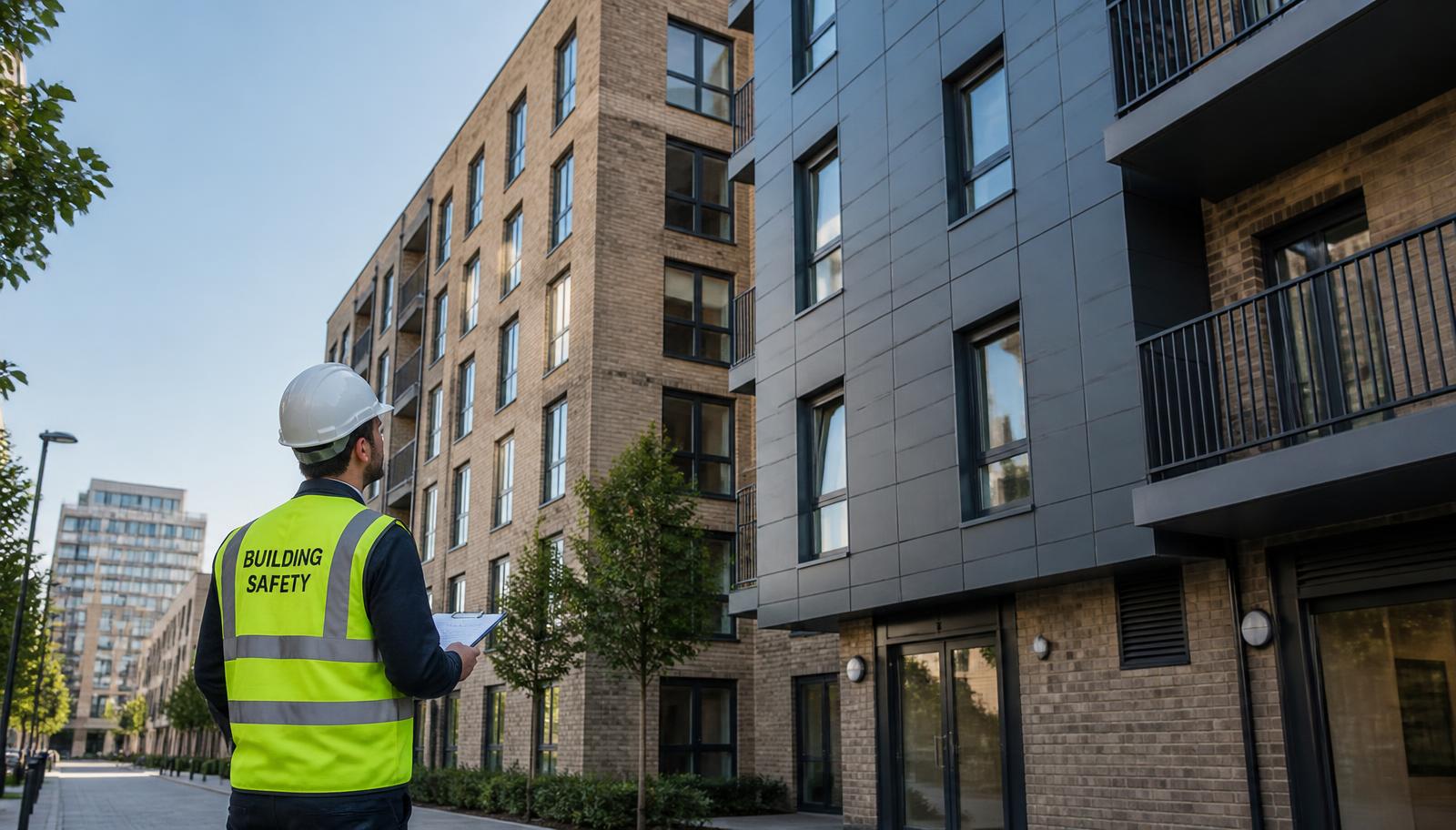
Building safety - Stratford and Newham
Fire Safety, Cladding and Selling Flats in Stratford: What Leaseholders Need to Know
Why external wall and fire safety issues have affected some Stratford buildings, what protections leaseholders now have, and the practical steps directors and flat owners can take when a building safety issue is unresolved.
Short answer
Stratford and the wider Newham area contain a large amount of purpose-built apartment stock, and some of those buildings have been affected by external wall and wider fire safety investigations carried out since the Grenfell Tower fire in 2017. Where issues are unresolved, they can complicate sales, remortgages, lender enquiries, external wall documentation, insurance, major works and service charge administration. That does not mean flats in buildings with cladding cannot be sold. The position depends on the individual building, what assessment has been done, the lender involved, the remediation status and the documentation available. Buildings with clear records and a funded plan tend to transact far more easily than buildings where nothing has been established.
Why has fire safety become such an issue in Stratford?
After the Grenfell Tower fire in June 2017, external wall systems on residential buildings across England were reassessed. What began as an examination of aluminium composite material (ACM) cladding widened over time into a broader review of external wall construction: insulation, cavity barriers, balcony construction and, in some buildings, internal compartmentation and fabric.
Stratford has a high concentration of buildings of exactly the type caught by that reassessment. Much of the leasehold stock across E15 and E20 is modern, purpose-built apartment accommodation with lifts, communal plant and shared amenity space, a large part of it delivered during the regeneration that followed the 2012 Olympic Games.
The scale of the local picture is documented. In June 2022, Newham Council launched a Cladding Action campaign and the Mayor of Newham wrote to companies, owners and developers of blocks with ACM cladding, referring to approximately 15,000 flats in privately owned blocks in the borough and warning of enforcement action where required fire safety works were not completed. That figure is a 2022 statement of the position at that time; it is not a current count of unremediated buildings, and the number of affected buildings has changed as remediation has progressed.
It is equally important to say what this does not mean. It does not mean that Stratford buildings generally have defects. Many buildings were assessed and found to require no works. Others have been remediated and signed off. The problem is concentrated in specific buildings, and the answer for any given block comes from that block's own assessment, not from a borough-wide statistic.
East Village: one of the UK's most significant building safety cases
East Village in Stratford was built as the athletes' village for the London 2012 Olympic and Paralympic Games and converted afterwards into residential accommodation, containing a mix of social housing and market housing. The estate is now the subject of litigation that has become one of the most closely followed building safety disputes in the country.
According to the UK Supreme Court's published case summary, the original developer of the blocks was Stratford Village Development Partnership (SVDP), which has in effect been owned by Get Living PLC since 2018. The blocks are managed by East Village Management Limited (EVML), which was granted a 1,000 year headlease in November 2016 and has contractual responsibilities for remedying defects. Triathlon Homes LLP, a social housing provider, holds the social housing element.
The Supreme Court summary records that, following the Grenfell Tower fire, EVML reviewed the cladding materials used in the blocks and serious fire safety defects were discovered. Government funding through the Building Safety Fund, administered in London by the Greater London Authority, was confirmed for the major remediation works. A contract was entered into in December 2022, works started in April 2023, and a Grant Funding Agreement between the Secretary of State, the GLA and EVML followed on 1 June 2023. Under that agreement EVML agreed not to claim the cost of the works from any leaseholder.
Separately, in a London Assembly Mayor's Question response published in April 2023, the Greater London Authority recorded that the London Legacy Development Corporation was in regular contact with Delancey and Get Living on fire safety, and that East Village Management Limited was actively pursuing a scheme of re-cladding for existing buildings that did not meet current fire safety standards. That is a 2023 record of the position at that date.
The £432m figure: what it is, and what it is not
Housing trade press has reported that East Village Management Limited increased its provision for fire safety remediation to approximately £432.7m in its published 2023-24 accounts, up from around £95.3m in 2023, after further defects were identified within the internal fabric of buildings. That figure is a remediation provision recorded by the management company for the estate. It is not a bill charged to leaseholders, and it should not be read as an amount that individual flat owners have been asked to pay. Who ultimately bears remediation costs at East Village is precisely what the litigation is about.
The litigation and the current Supreme Court position
In December 2022 Triathlon Homes applied to the First-tier Tribunal for remediation contribution orders under section 124 of the Building Safety Act 2022 against SVDP and Get Living. A remediation contribution order requires a specified body, which can include the developer or a person associated with the developer, to contribute to the cost of remedying relevant defects where the Tribunal considers it just and equitable.
The First-tier Tribunal found the statutory conditions met and made the orders. The Court of Appeal upheld that decision in Triathlon Homes LLP v Stratford Village Development Partnership and others [2025] EWCA Civ 846, handed down on 8 July 2025.
The matter has since gone to the Supreme Court as Stratford Village Development Partnership and another v Triathlon Homes LLP and another (UKSC/2025/0156). On 6 November 2025 the Supreme Court granted permission to appeal in part: permission was refused on the "just and equitable" ground and granted on the question of whether a remediation contribution order can be made in respect of costs incurred before section 124 came into force on 28 June 2022. The appeal is linked to Adriatic Land 5 Limited v Long Leaseholders at Hippersley Point (UKSC/2025/0157), which raises a related retrospectivity question under Schedule 8.
At the time this article was published, the Supreme Court's case page recorded the appeal as listed for hearing, with no judgment published. We are not predicting the outcome, and readers should check the official case page for the current position before relying on this summary.
The case matters well beyond Stratford. It concerns how far the Building Safety Act 2022 reaches back in time and how responsibility for historical remediation costs is allocated between developers, building owners and public funding. Its outcome will be relevant to RTM companies, resident management companies and leaseholders across England.
This section describes documented public proceedings and published records. Nothing in it should be read as an allegation of wrongdoing against any organisation, and East Valley Properties has no involvement with East Village or any of the parties.
Can fire safety problems make a Stratford flat difficult to sell?
They can, and it is worth being precise about why. The difficulty is rarely the existence of cladding in itself. It is usually the absence of settled information at the moment a transaction needs it.
- Lender requirements. Mortgage lenders set their own criteria for lending on flats in buildings with external wall issues, and those criteria differ between lenders.
- Valuation. A valuer may treat unresolved external wall issues, or an unknown remediation cost, as material to value or saleability.
- External wall enquiries. A valuer may request external wall information, including an EWS1 form, where the building meets the criteria in the applicable RICS professional standard.
- Assessment documentation. Whether a FRAEW carried out to PAS 9980 exists, and what it concluded.
- Outstanding remediation. Works that are identified but not yet started, or started but not completed.
- Uncertainty over who pays. An unquantified or unallocated remediation cost is harder for a buyer to accept than a large but funded one.
- Incomplete building records. Enquiries that cannot be answered from the building's own file cause delay.
- Anticipated major works. Section 20 consultation under way, or a reserve fund position that a buyer's solicitor will want explained.
The practical conclusion is that documentation and clarity are what move transactions. Two buildings with similar construction can behave very differently in the market if one has an assessment, a funded remediation plan, a timetable and a records pack, and the other has none of those things.
EWS1, FRAEW, PAS 9980 and the Fire Risk Assessment
These four things are routinely confused, including in conveyancing correspondence. They are not interchangeable.
EWS1 form
A one-page form used to communicate the outcome of an external wall investigation to valuers and lenders. It is a valuation tool, not a statutory certificate, and it is not required for every building. RICS published a second edition of its professional standard on secured lending valuation of properties in multi-storey, multi-occupancy residential buildings with cladding in May 2026, effective from 1 November 2026, which sets out when an EWS1 should be requested and states that it should only be requested where there is a clear rationale. Lenders and trade bodies have also updated their positions on matters such as the age of an EWS1 form and the validity of the signatory, so an existing form is not always the end of the question.
FRAEW
A fire risk appraisal of external wall construction: a technical assessment by a suitably qualified professional of the risk presented by the external wall, and what should be done about it. This is the substantive assessment that sits behind any EWS1 rating.
PAS 9980
The published methodology commonly used to carry out a FRAEW. It supports a risk-based, proportionate judgement rather than a simple pass or fail on materials alone. A report described as a PAS 9980 assessment is usually a FRAEW carried out to that methodology.
Fire Risk Assessment
The assessment required under the Regulatory Reform (Fire Safety) Order 2005 for the common parts of a residential building. It covers the whole fire safety picture - escape routes, doors, alarms, management arrangements - and is a separate, ongoing legal duty. It does not answer external wall questions on its own.
The single most common misunderstanding is the belief that "you need an EWS1 to sell a flat". You do not. Whether external wall information is required depends on the building, the transaction and the lender. Commissioning an EWS1 that nobody has asked for, on a building that does not meet the criteria, can cost money and achieve nothing.
Who pays for cladding and fire safety remediation?
The Building Safety Act 2022 introduced leaseholder protections which came into force on 28 June 2022. In broad terms, GOV.UK guidance explains that the protections apply to qualifying leaseholders in relevant buildings - buildings above 11 metres or five storeys - with historical safety defects, and that qualifying leaseholders in relevant buildings are protected in law from the costs of remediating an unsafe cladding system. Protection against other, non-cladding historical defect costs also exists, but works differently and is subject to caps and conditions.
Alongside the statutory protections there are funding and industry routes: the Cladding Safety Scheme delivered by Homes England, the Building Safety Fund, and the developer remediation contracts under which a large number of major developers committed to remediate life-critical fire safety defects in buildings they had a role in developing.
Where liability lands in any particular building depends on matters including:
- the type of defect, and whether it concerns cladding or other fire safety issues;
- the building itself, including its height and whether it is a relevant building;
- whether an individual lease is a qualifying lease;
- the developer, freeholder and landlord relationships and their financial position;
- the statutory protections and any applicable caps;
- whether a funding scheme or developer contract applies to the building.
Two cautions. First, this is general information, not advice on your building. Second, it is not correct to say that all leaseholders are protected from every fire safety cost. The protections are significant, particularly for cladding, but they are conditional, and questions about qualifying status and cost recovery should be put to a solicitor.
What about buildings under 11 metres?
This is an area where the policy position has moved, and older assumptions are now out of date. The statutory leaseholder protections in the Building Safety Act 2022 are tied to relevant buildings of at least 11 metres or five storeys, so lower-rise buildings sit outside that regime.
However, in guidance published on 9 July 2026, the Ministry of Housing, Communities and Local Government announced new funding for eligible buildings under 11 metres through the Cladding Safety Scheme, delivered by Homes England. The guidance states that this delivers a commitment made in the Remediation Acceleration Plan Update of July 2025 and supports a risk-based approach, with funding prioritised according to cladding fire safety risk and priority given to buildings presenting a high life-critical cladding fire safety risk. Applications open on 17 August 2026 and close eight weeks later.
The department's stated position remains that buildings under 11 metres are less likely to have widespread cladding fire safety risks, and funding is directed at eligible cases where a fire risk appraisal supports the need for cladding remediation. If you are a director of a low-rise block with an identified cladding issue, read the current GOV.UK guidance carefully rather than assuming there is no route to support - and note the application window.
What leaseholders should ask their managing agent
Put these in writing and ask for written answers. Where the honest answer is "we do not know yet", that is still useful - it tells you what needs to be established next.
Has the external wall been assessed?
Ask what assessment has been carried out on the external wall construction, when, and by whom.
Is there an FRAEW or PAS 9980 assessment?
Ask whether a fire risk appraisal of external wall construction exists and whether you can see the report or a summary.
Is an EWS1 available, and is one actually needed?
An EWS1 is not required for every building. Ask whether one exists, who signed it, when, and whether the building falls within the criteria valuers use.
What defects have been identified?
Ask for a plain list: cladding, insulation, cavity barriers, balconies, compartmentation or internal fabric.
Are interim measures in place?
Waking watch, simultaneous evacuation, temporary alarms or revised evacuation strategy, and how long they are expected to last.
Who is responsible for remediation?
Freeholder, developer, headlessee, management company or a combination. Ask who is legally on the hook for the works.
Has funding been applied for?
Cladding Safety Scheme, a developer remediation contract, a warranty claim or a legal claim - and what stage each is at.
Is the developer involved?
Whether the original developer has accepted responsibility, and whether any agreement or proceedings exist.
What is the remediation timetable?
Assessment, design, procurement, consultation, works and completion, with the dates currently expected.
Are leaseholders protected from the costs?
Whether the building is a relevant building, whether leases qualify, and which costs are within the statutory protections.
What can be given to lenders and conveyancers?
The pack a buyer's solicitor will ask for: assessments, remediation status, funding position, insurance and service charge information.
What communication have residents had?
Written updates, meetings, a named contact and a record of what has been shared and when.
What happens once remediation completes?
Sign-off documentation, updated assessments, warranty position and how that information is retained for future sales.
Why good managing agent communication matters
A managing agent cannot make a construction defect disappear. It cannot decide who is liable, it cannot guarantee government funding, and it cannot promise that a flat will sell. What it can do is run the process properly, and on a building safety project that makes a substantial difference to how long everything takes and how much leaseholders understand.
In practice, effective management of a building safety issue means coordinating suitably qualified fire safety professionals, arranging FRAEW or PAS 9980 assessments, progressing the EWS1 process where it is genuinely required, maintaining communication with the freeholder or developer, supporting funding applications where that falls within the responsible entity's remit, appointing contractors and professionals, running Section 20 consultation where required, keeping residents informed, holding the documents lenders and conveyancers ask for, and administering the service charge so building safety costs are visible and correctly treated.
Two qualifications matter. A managing agent should not be signing an EWS1 form unless the individual is appropriately qualified to do so, and no agent should be presenting its view of statutory liability as a legal conclusion. Those are jobs for fire engineers and solicitors respectively.
How East Valley can help Stratford blocks
Where directors or leaseholders are dealing with an unresolved fire safety issue, our role as managing agent is to bring structure, transparency and momentum to the management side of it. We provide block management in Stratford and across East London from our Romford-based team, working for RTM companies, RMCs, share of freehold companies and freeholders.
Coordinating specialist assessments
Instructing suitably qualified fire engineers and consultants on behalf of the client company, and keeping the process moving.
Organising the building safety file
Assessments, reports, correspondence, funding applications and works records held in one place and kept current.
Obtaining and comparing quotations
Running a documented procurement process for professional and contractor appointments, with costs presented clearly to directors.
Communication with directors and leaseholders
Regular written updates so residents know the position, even when the answer is that a report is still awaited.
Section 20 consultation where required
Running the statutory consultation process properly where qualifying works or long-term agreements are involved.
Service charge administration
Budgets, accounts and demands prepared so building safety costs, and any statutory limits on recovering them, are handled transparently.
Answering conveyancing enquiries
Responding to leaseholder and solicitor enquiries from the records actually held for the building.
Insurance information
Keeping insurance documentation and any fire-safety-related terms available to directors and leaseholders.
To be clear about scope: we coordinate and administer. We do not carry out fire engineering, we do not sign EWS1 forms, we cannot determine statutory liability, and we cannot guarantee funding outcomes, mortgageability or the sale of any individual flat.
Is your managing agent making progress?
Complex building safety projects legitimately take time. Assessments have to be commissioned, specialists are in demand, funding decisions sit with third parties and works on occupied buildings are slow by nature. Delay on its own is not evidence that an agent is doing a poor job.
What directors can reasonably expect, though, is clear information: what has been established, what the identifiable next step is, which professional reports exist and what they say, what records are held, what the budget position is, where any funding application stands, regular updates and a straightforward explanation when something slips.
If an RTM company, RMC or resident-controlled block is considering changing managing agent because management has stalled, it is worth being realistic: a new agent does not resolve remediation or change who is liable. It can restore process, records and communication, which is often what has actually broken down. Our RTM company management service and published fee approach set out how we work with resident-led boards.
What does this mean in practice?
If you are one of the rtm directors
- Establish in writing what external wall assessment exists for your building, and its date.
- Ask whether any funding route - Cladding Safety Scheme or developer contract - has been explored, and record the answer.
- Keep a single building safety file so leaseholder and conveyancer enquiries can be answered consistently.
If you are one of the freeholders
- Confirm whether the building is a relevant building and how the leaseholder protections affect cost recovery.
- Take legal advice before demanding any building safety cost through the service charge.
If you are one of the leaseholders
- Ask your agent the checklist questions in writing before you market your flat.
- Check with your lender or broker what information they need, rather than commissioning an EWS1 speculatively.
Common mistakes
Assuming an EWS1 is legally required to sell
It is a valuation tool, not a statutory certificate. Whether one is needed depends on the building and the lender.
Treating a Fire Risk Assessment as an external wall assessment
An FRA covers the common parts and fire safety management. It does not answer external wall construction questions on its own.
Assuming a low-rise block has no funding route
MHCLG opened new Cladding Safety Scheme funding for eligible under-11-metre buildings in 2026. Check the current guidance and the application window.
Reading a remediation provision as a leaseholder bill
Large estate-level remediation figures reported in the press are programme or provision figures. They are not sums demanded from individual flat owners.
Waiting for certainty before communicating with residents
Silence causes more damage than an interim update. Residents can handle 'not yet known' far better than nothing at all.
When to seek professional advice
Most questions on this topic are management questions rather than legal ones, and the two are worth separating. A managing agent can tell you how something works day to day and what it will cost. A solicitor tells you what your rights are and how a Tribunal is likely to view them.
Speak to a managing agent when
- You need assessments coordinated, documented and reported to directors on a timetable.
- Section 20 consultation is needed for remediation or associated professional appointments.
- Conveyancing and lender enquiries about your building cannot currently be answered from the records held.
Take specialist legal advice when
- Whether your lease is a qualifying lease, or your building a relevant building, determines who pays.
- A building safety cost is being demanded through the service charge and its recoverability is in doubt.
- A claim against a developer, warranty provider or freeholder is being considered, or a remediation contribution order is in contemplation.
East Valley Properties provides management expertise, not legal advice. Where a matter turns on the wording of your lease or on formal proceedings, we will say so and work alongside your solicitor.
Primary sources and further reading
The official material behind this guide. We summarise it in plain English rather than reproducing it.
- UK Supreme Court - Stratford Village Development Partnership and another v Triathlon Homes LLP and another (UKSC/2025/0156)
Official case page: parties, issues, facts and current status. Check here for the up-to-date position.
- UK Supreme Court - Adriatic Land 5 Limited v Long Leaseholders at Hippersley Point (UKSC/2025/0157)
Linked appeal on retrospectivity under Schedule 8 to the Building Safety Act 2022.
- Building Safety Act 2022 (legislation.gov.uk)
Including section 124 remediation contribution orders and Schedule 8 leaseholder protections.
- Building safety leaseholder protections: guidance for leaseholders (GOV.UK)
MHCLG plain-English explanation of the protections and how they apply.
- How will cladding costs be paid for? (GOV.UK)
Government position on funding cladding remediation in buildings over 11 metres.
- Buildings under 11 metres: new funding (GOV.UK, published 9 July 2026)
Cladding Safety Scheme funding for eligible low-rise buildings, with applications opening 17 August 2026.
- Cladding Safety Scheme (Homes England)
Eligibility and application process for the main remediation funding scheme.
- Newham Council - Cladding Action
The Council's campaign page, launched June 2022, covering privately owned blocks in the borough.
- Greater London Authority - Fire Safety Standards, East Village (Mayor's Question 2023/0763)
Answer published April 2023 recording EVML pursuing a re-cladding scheme.
- RICS - Secured lending valuation of properties in multi-storey, multi-occupancy residential buildings with cladding
Second edition published May 2026, effective 1 November 2026, on when an EWS1 should be requested.
- Regulatory Reform (Fire Safety) Order 2005 (legislation.gov.uk)
The duty to carry out and maintain a Fire Risk Assessment for the common parts.
- Find Case Law - Court of Appeal and tribunal judgments (National Archives)
Full text of judgments including Triathlon Homes LLP v Stratford Village Development Partnership [2025] EWCA Civ 846.
Please note: this article is general information about residential block management and building safety. It is not legal, fire engineering or valuation advice. Building safety law and government funding policy are changing quickly, and the position for any individual building depends on its construction, height, leases and assessment history. Take specialist advice before acting. Published 9 August 2026; last updated 9 August 2026.
Written by Romain Maillard - Director, East Valley Properties
Romain manages residential blocks and estates for RTM companies, residents' management companies, share of freehold developments and freeholders across East London and Essex.
Published
Based on the legislation and official guidance cited on this page.
General property management information, not legal or professional advice. Where a decision depends on an individual lease, building, dispute or technical assessment, obtain specialist advice. See our editorial standards.
Frequently Asked Questions
Readers also ask
- New Cladding Funding for Buildings Under 11 Metres: What RMC and RTM Directors Need to KnowBuilding Safety · 11 min read
- Self-Managed Block Fire Safety ChecklistFire Safety & Compliance · 15 min read
- Section 22 Notices: How Much Detail Do Leaseholders Need to Give?Leasehold Law · 9 min read
- Late Service Charge Demands: Why the Dates in Your Lease MatterService Charges · 8 min read
- Building Safety Act: Upper Tribunal Clarifies the Scope of Cladding RemediationBuilding Safety · 9 min read
Related articles
New Cladding Funding for Buildings Under 11 Metres: What RMC and RTM Directors Need to Know
New government funding for unsafe cladding on eligible residential buildings under 11 metres in England: who may qualify, why a FRAEW is essential, who can apply and the 9 October 2026 deadline.
Read guideSelf-Managed Block Fire Safety Checklist
A practical, printable checklist for directors of RTM companies, RMCs and small self-managed blocks: fire risk assessments, fire doors, escape routes, systems, records and the frequencies that are actually statutory.
Read guideSection 22 Notices: How Much Detail Do Leaseholders Need to Give?
An Upper Tribunal decision clarifies how much detail a Section 22 preliminary notice must contain before leaseholders apply for a Tribunal-appointed manager under Section 24.
Read guideHave a Question About Your Building?
Whether you're an RTM Director, RMC Director, Freeholder or Leaseholder, our experienced block management team is here to help.
If your question could help other property owners, we may publish an anonymised version of the answer in our Knowledge Centre.
Need advice sooner?
Book a free consultation with East Valley Properties to discuss your building, service charges, compliance or managing agent requirements.
Concerned about fire safety at your Stratford block?
We can discuss the management and coordination of building safety issues with RTM companies, RMCs and resident-controlled developments - assessments, records, contractors, consultation and communication. Specialist legal, fire engineering or building safety advice may also be required depending on the issue.